


ELTE PPK Institute of Education organized their annual symposium together with San Jose State University.
How do we ensure that learning in the age of Artificial Intelligence becomes more meaningful, rather than simply easier?
This question was central to the "AI Futures in Education 2026" symposium, organized by the ELTE PPK Institute of Education (Attila Rausch, László Horváth, Zoltán Rónay) and San Jose State University, Center for Innovation in Applied Education Policy (Brent Duckor, Carrie Holmberg).
Focusing on the theme of "Agency in the Age of Artificial Intelligence," the event brought together educators and researchers to discuss the pedagogical and ethical implications of AI. Welcomed by the Dean of SJSU’s Connie L. Lurie College of Education, Dr. Adrienne Redmond-Sanogo via video and Dean Andrea Dúll of ELTE’s Faculty of Education and Psychology, attendees explored how to maintain human judgment, student voice, and educator expertise as AI tools become more prevalent in academic settings.
Deeper Learning and The "Five Pillars of Practice"
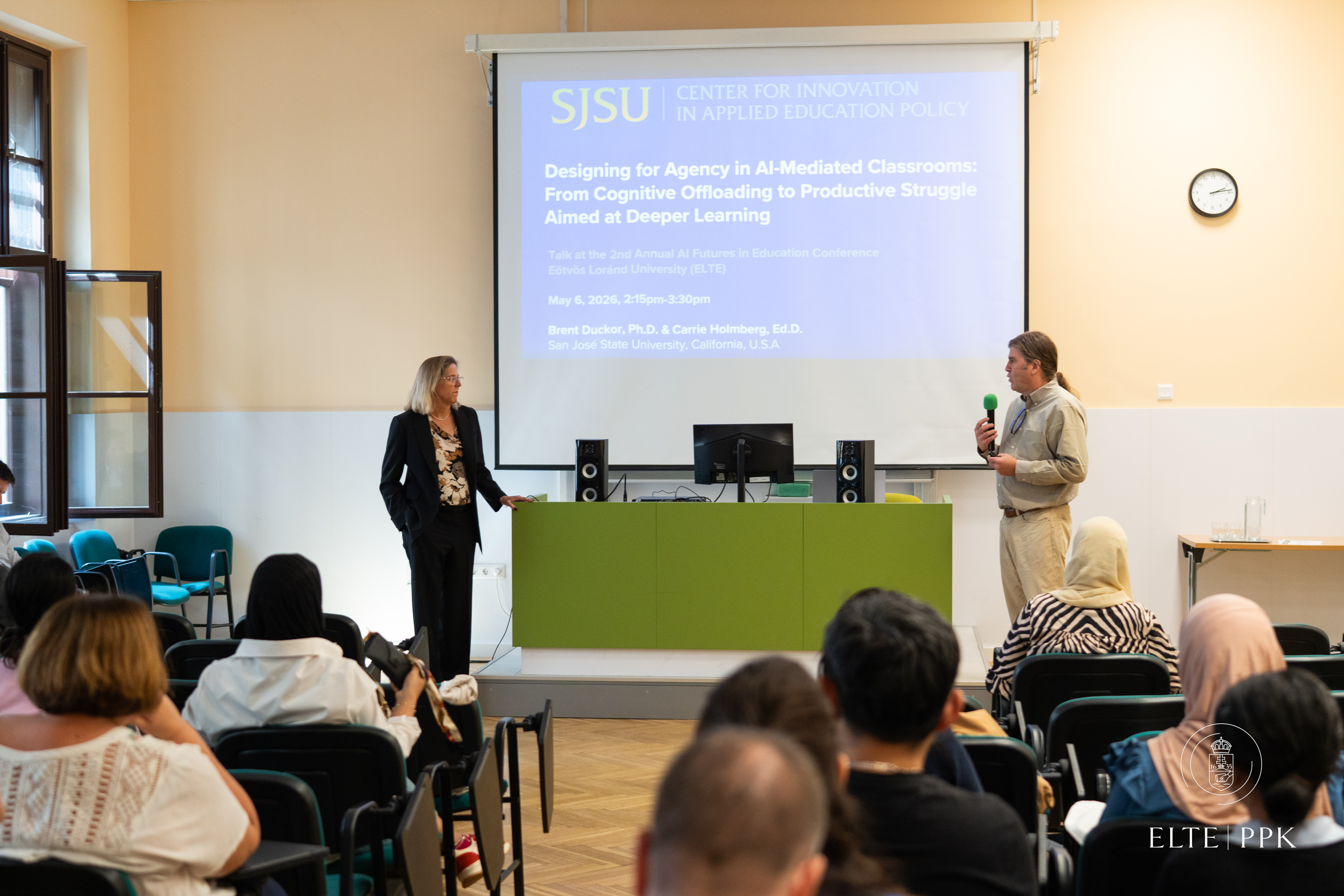
In the opening keynote, SJSU’s Brent Duckor and Carrie Holmberg (based on their upcoming book) discussed the risk of AI functioning as a "neo-behaviorist" system, where learning is reduced to instant gratification and simple inputs and outputs. To help ensure students maintain the "productive struggle" necessary for cognitive development, Holmberg introduced a diagnostic framework for educators called The Five Pillars of Practice:
- Accuracy: Understanding the context and provenance of truth claims, rather than just checking for correctness.
- Agency: Ensuring learners maintain intellectual responsibility and do not bypass the learning process.
- Accessibility: Distinguishing practical educational access from a mere "simulation of access."
- Assessment: Shifting the focus from grading the final product to evaluating the learning process.
- Authenticity: Tracing the student’s actual effort, thinking, and unique voice in their work.
Digital Competence and "Friction by Design"
Addressing the gap between rapid technological innovation and current educational readiness, ELTE's Attila Rausch emphasized the need to align AI literacy with frameworks like the EU's DigComp 3.0 and the OECD. Rausch noted that without structured competencies such as critical thinking, AI might replace traditional information gathering with a passive reliance on generated content, potentially reducing human agency.
Building on this, the presentation by ELTE’s László Horváth on cognitive outsourcing outlined how humans interact with AI across three levels: Cognitive Offloading (reducing demands for basic tasks), Cognitive Delegation (using AI as a guided assistant), and Cognitive Outsourcing (transferring actual reasoning to AI, creating an "illusion of learning"). The presentation suggested that educators should implement "friction by design"—deliberately keeping the necessary challenges required for actual cognitive development.
Reevaluating Assessment and Academic Ethics
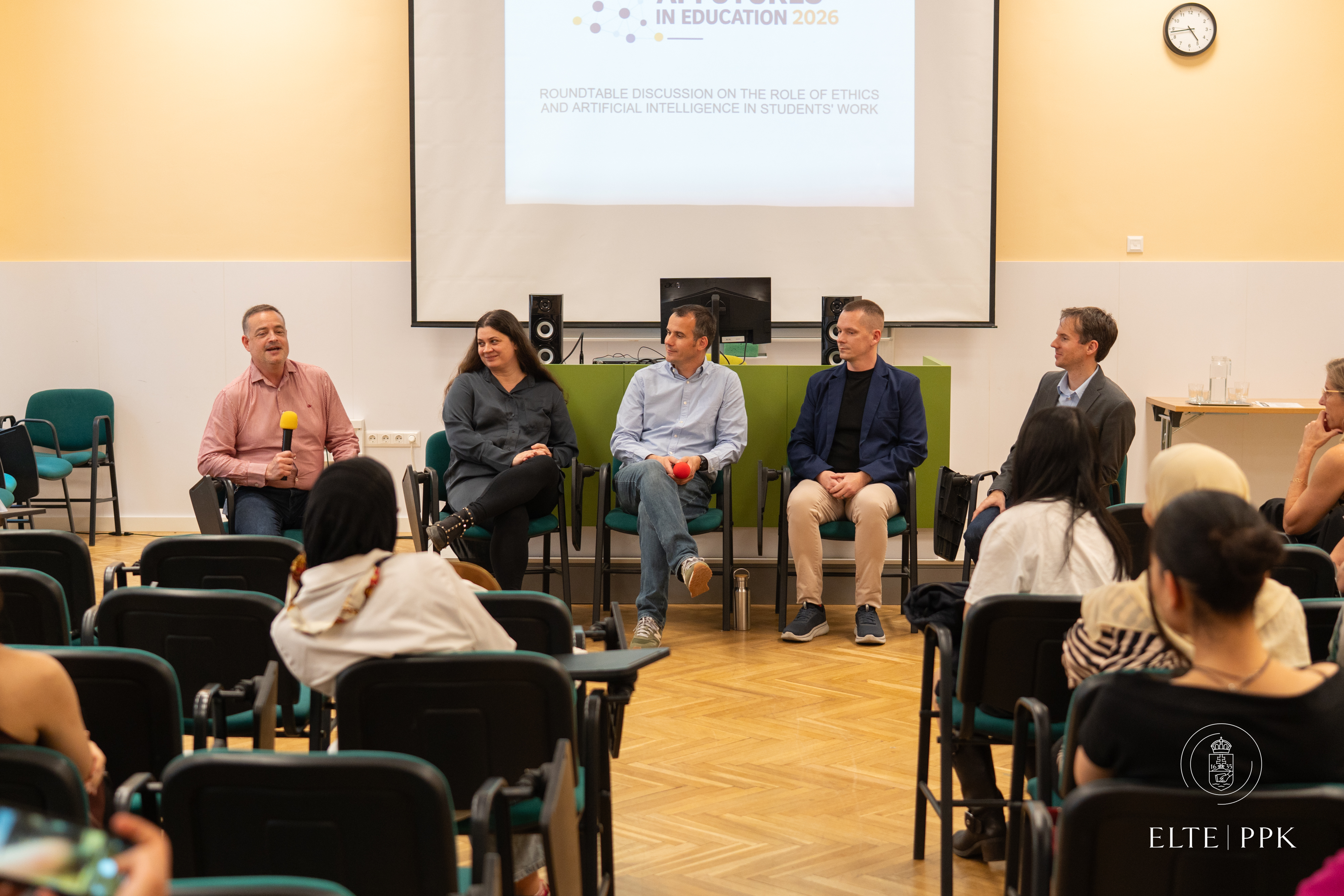
With current AI detection tools proving unreliable, the challenge of assessing student work was the focus of a roundtable moderated by Zoltán Rónay. The panel included representatives from the Humanities, Law, Special Needs Education, and Education and Psychology faculties:
- Kata Baditzné Pálvölgyi, Associate Professor with habilitation, at the Faculty of Humanities, Institute of Romance Studies, Department of Spanish Language and Literature;
- Endre Horváth, Lecturer at the Bárczi Gusztáv Faculty of Special Needs Education, Institute of Special Needs Education for People with Atypical Behaviour and Cognition;
- Zoltán Pozsár-Szentmiklósy, Associate Professor with habilitation, at the Faculty of Law, Department of Constitutional Law, where he is the Vice Dean for education and also the Head of the Department of Constitutional Law and
- Attila Rausch, PhD, Assistant Professor at the Eötvös Loránd University Faculty of Education and Psychology, Institute of Education, and is also the Chair of the Research Ethics Committee.
The group suggested that traditional evaluation methods, like the standard thesis, may need to be updated. Proposed alternatives included continuous portfolios, oral defenses, and in-class problem-solving to verify student comprehension. The panel also noted responsible applications of AI, such as using it as a supplemental tutor, aiding with statistical coding (like R), and assisting with language barriers in legal research. On the other hand, the group also agreed on looking at AI not only as a negative phenomenon but also acknowledged its benefits. They concluded to the importance of balance in using AI.
A Pedagogical Focus
Brent Duckor closed the symposium by summarizing the overarching themes, noting that the integration of AI in education is primarily a pedagogical issue rather than a technological one. As educational structures adapt to these tools, approaches to the "novice-expert distinction" and information access are shifting. The event concluded with a reminder of the continuing importance of face-to-face academic collaboration and human connection in educational settings.
(The organisers delegated the cognitive and operative task of creating this report to generative AI. The report was created based on the automatic transcript of the streamed video with the help of NotebookLM and Google Gemini 3.1 Pro. The content was verified by the organisers.)